

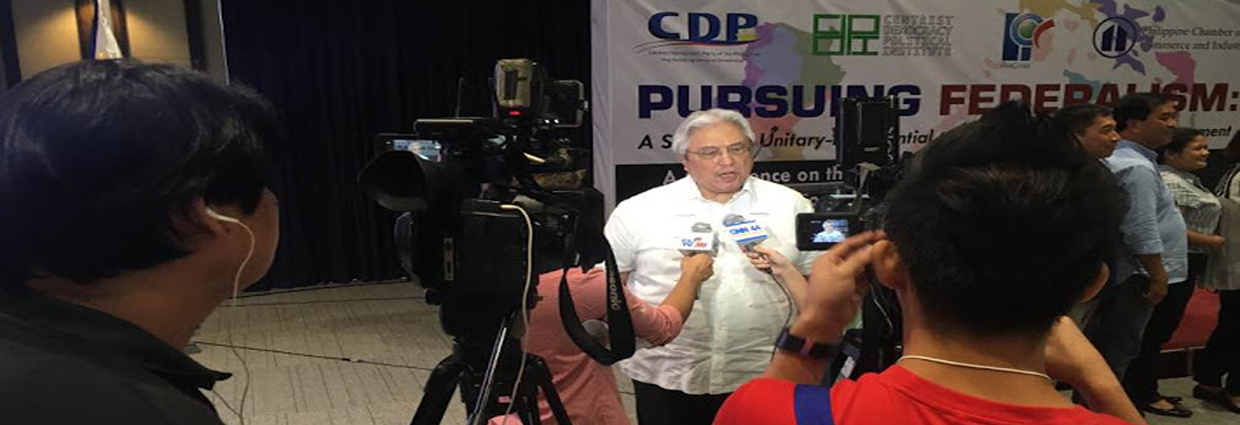
No real political parties, just politicians

LAST week, I argued that the Philippines possesses an abundance of politicians but practically no genuine political parties. This would merely be another amusing defect of Philippine democracy were it not for what I am proposing.
I have long advocated replacing our unitary-presidential system with a parliamentary system, eventually operating within a federal republic. There is, however, an inconvenient detail.
Parliamentary government cannot function properly without real political parties.
Otherwise, we might be abolishing our dysfunctional presidential system only to discover that we have transferred the same political families, oligarchs, butterflies and balimbings into a shiny new parliament. We would have changed the plumbing while keeping the sewage.
Parliament is not a prime minister
Many Filipinos understandably think parliamentary government simply means replacing the president with a prime minister.
It does not.
If that were all we wanted, we could change the brass plate outside Malacañang and save ourselves the trouble of constitutional revisions. The fundamental difference is political accountability.
Under our presidential system, we elect one enormously powerful national personality for six years. Once elected, he assembles a Cabinet, negotiates with Congress, distributes political favors, builds coalitions and attempts to govern a political establishment consisting of people who may have campaigned against him only weeks earlier.
Then comes the migration of political butterflies: enemies become allies, allies rediscover principles, blocs appear overnight. It is musical chairs to “Bayan Ko,” with everyone claiming he moved seats for the national interest.
A functioning parliamentary system changes the organizing principle: voters choose parties offering governing programs; the majority forms the government, its leader becomes prime minister, ministers answer to parliament and an organized opposition presents an alternative. This is why I favored parliamentarism: It provides continuous scrutiny through question periods, opposition discipline and party accountability. But the essential ingredient is real parties. Without them, the machinery collapses.
Imagine our present parties in parliament
For entertainment, let us imagine transferring today’s political habits unchanged into a parliamentary system.
Election Monday: Party A wins a plurality.
Tuesday: Party B congratulates Party A.
Wednesday: Seventeen members of Party B discover that they have always secretly admired Party A’s philosophy.
Thursday: Party C joins the government in the interest of national unity.
Friday: Party D splits into D-Original, D-Puso, D-Tunay and D-One More Chance.
Saturday: Everyone issues statements denying political opportunism.
Sunday: Rest.
Monday: Cabinet appointments.
We would have invented parliamentary government, Filipino style.
The problem is not parliamentarism. The problem is putting parliamentary institutions atop a political culture organized around personalities, patronage and dynasties.
That is why political-party reform is not an accessory to constitutional reform. It is a precondition.
In a genuine parliamentary system, voters must know what a party stands for: welfare or markets, autonomy or centralization, higher taxes or tax cuts. Coalitions may compromise, but elections must still offer real choices — not merely vows to end poverty, fight corruption and create jobs. No party campaigns for poverty, corruption or disorder. The serious question is how.
From patronage to program
Here, the institutionalization of parties becomes revolutionary. Imagine Philippine politicians depending less upon the favor of one president because their political careers depend upon strong parties with dues-paying members, transparent financing, local organizations and established procedures for selecting candidates.
Imagine aspiring leaders entering politics through parties that educate and train them instead of through famous surnames. Imagine political parties existing 12 months a year rather than being resurrected every election like Lazarus.
Imagine elected representatives being accountable not only to whoever financed their campaign but to thousands of ordinary party members who can demand explanations.
This is what we attempted to inculcate in the Centrist Democratic Party (CDP): membership ownership, political education, internal elections, party discipline, a program of governance and continuous community engagement between elections.
Again, I cite this not to canonize CDP. Political experiments have successes and failures. But the institutional principle remains sound.
Federalism and dynasties
Here lies another danger.
Federalism without political reform could simply decentralize political capture. Instead of one centralized oligarchic system, we could create several regional oligarchic systems, each with its own governor, dynasty and family corporation masquerading as democracy.
Congratulations. We would have democratized feudalism. I warned about precisely this problem years ago. Political-party reform was one of four preconditions we proposed before a full transition: party reform and financing, freedom of information, electoral reform and an effective prohibition against political dynasties.
Federalism is supposed to bring the government closer to the people. But without safeguards, it could bring political dynasties closer to the treasury. That is why the sequence matters.
First build the vehicles
We Filipinos are fond of constitutional solutions. Government fails, somebody proposes Charter change; somebody else shouts dictatorship; then a new scandal arrives, and we forget what the argument was about.
But constitutions do not operate themselves. They need institutions, and in a democracy, the vehicles are real political parties — aggregating interests, recruiting leaders, forming governments and sustaining an opposition.
A parliamentary constitution without genuine political parties is like constructing an expressway before inventing automobiles. The road may be beautiful. Nothing useful will travel on it.
No more political messiahs
Our presidential system has trained Filipinos to place political hope in one individual. Every six years we ask: Who can save us?
Makoy promised a New Society. Cory restored democracy. Tabako promised Philippines 2000. Erap championed the masses. GMA offered economic management. PNoy promised the straight path. The Deegong promised order. BBM offered unity.
Different presidents. Different promises. Same republic waiting for the next one. A parliamentary system properly supported by genuine political parties changes the question.
I used to tell our CDM/CDP recruits that even if Jesus Christ were to come down and is elected president, with the 12 disciples composing his cabinet; with our system intact — Christ will fail.
Instead of asking who will save us?, voters should begin asking: Which program should govern us? That is an enormous psychological and institutional shift.
From man to institution. From patron to party. From personality to program. From messiah to mechanism.
Before we change the Constitution
Thus, my advocacy that the Philippines must have a federal-parliamentary architecture. But I am equally persuaded that merely rewriting constitutional provisions will not save us.
We must first — or simultaneously — construct the institutions capable of inhabiting that architecture. Foremost among them are genuine political parties: member-owned, ideologically identifiable, internally democratic, financially transparent, active between elections and capable of disciplining their own elected officials.
Otherwise, we will write a magnificent new Constitution and populate it with the same political habits that corrupted the old one. The butterflies will survive. They always do. They will simply learn to flutter around parliament instead of Malacañang.
And that brings me finally to the conclusion toward which my domestic series of columns have been moving. After decades watching Philippine politics, participating in it, studying it, writing about it and hoping that the next president may somehow succeed where the others failed, I have gradually arrived at a position I once would have considered too sweeping.
The problem is no longer merely who becomes president.
The problem may be the presidency itself.
Our great Philippine political butterfly sanctuary

SINCE the 1900s, American-style democracy taught us its rituals, which we embraced with enthusiasm but imbued with local pinoy flavor: festive campaigns, songs, “budots” dances, baby-kissing and, on rare occasions, some discussion of public policy.
Then we vote.
What happens afterward is another matter. We have political parties. There is the Nacionalista Party, Liberal Party, PDP-Laban, Lakas-CMD and assorted others whose acronyms sometimes survive longer than their principles.
Yet ask the ordinary voter what fundamentally distinguishes one from another — economically, socially, constitutionally — and silence. Ask a politician, and he may first have to remember which party he currently belongs to.
Ideology for rent
We have perfected a uniquely Filipino species of political wildlife: the political butterfly. It flits gracefully from flower to flower particularly when the nectar in Malacañang changes every six years.
Yesterday Liberal. Today PDP-Laban. Tomorrow Lakas. The day after tomorrow — well, let us first see who is leading the presidential surveys.
This phenomenon is sometimes called political pragmatism. That is the respectable term. Ordinary mortals might call it opportunism. And for those less inclined toward diplomatic language — political prostitution.
I wrote years back that politicians genuinely adhering to a party because of ideology and values are an endangered species. Our political environment rewards adaptability instead. Personal popularity and local machinery frequently matter more than party principles.
We should perhaps stop criticizing these politicians. They are merely adapting to their habitat. The problem is the habitat.
Our parties are not really political parties in the mature democratic sense. They are temporary electoral corporations organized principally to win elections. Many become extremely energetic before election day and mysteriously fall asleep afterward. The technical term is hibernation.
Wanted: Winnability
Because parties possess little ideological identity, their overriding criterion becomes winnability. Thus begins the great Philippine talent search. Wanted: candidates for public office. Qualifications: preferably famous. Actors welcome. Athletes encouraged. Television personalities highly desirable. Social-media following advantageous. Ability to dance and sing during campaign rallies a plus.
Knowledge of public administration optional. Ideology? We will discuss that after the surveys. This is not an indictment of actors, athletes, or broadcasters. Some may become excellent legislators. It is a denunciation of a political system in which celebrity can substitute for preparation because parties themselves have largely abandoned their responsibility to identify, educate and develop future leaders.
I made this argument years ago: When winnability overwhelms ideological perspectives, parties naturally recruit people already popular with the masses, while political creed and principles retreat discreetly to the back room.
Then we blame the Filipino voter. We solemnly repeat: People deserve the government they elect. Perhaps. But democracy presupposes meaningful choices. If the menu offers adobo, adobo with egg, adobo without egg and yesterday’s adobo reheated under a different party acronym, blaming the customer for not ordering steak seems slightly unfair.
Who owns the party?
Here lies the more fundamental problem. In genuine political parties, ordinary citizens become members because they believe in something. They pay dues. They participate. They debate policy. They help select leaders and candidates. The party belongs to its members.
In the Philippines, members generally do not finance parties. Candidates themselves, political dynasties, business interests and wealthy patrons do. And whoever pays the orchestra normally selects the music. I argued this as early as 2013: When members do not pay dues, they possess no meaningful stake in the organization. The financiers become the real stakeholders and consequently acquire enormous influence over who runs and what programs are presented to voters.
This is patronage politics disguised as party politics. It also explains the famous migration toward whichever president occupies Malacañang. In our centralized presidential system, political manna traditionally descends from above. Congressmen and local officials therefore discover previously unsuspected philosophical affinities with the victorious president.
It is remarkable how rapidly ideological enlightenment occurs after an election.
What a real party should be
For decades, those of us in the Centrist Democratic movement argued that a genuine political party requires at least four things. First, real members who pay dues. Second, internal democracy and discipline. Third, an identifiable ideology translated into a program of government. Fourth, laws governing political parties, their financing and accountability.
At CDP we tried, imperfectly, to practice these principles. Members paid annual dues, underwent political orientation and training, participated in decision-making, and could vote and be voted into party positions. The party attempted to remain active in communities between elections rather than materializing every three years like a political apparition.
The point here is not that CDP discovered political salvation. We did not. The point is that political parties must become institutions rather than personal vehicles. They should recruit young people long before those young people become candidates. They should teach them political philosophy, economics, constitutional government and public administration. They should allow them to rise through party ranks. A future congressman should not suddenly discover public policy after winning an election. Neither should a future senator require his first committee hearing to discover what his committee does.
Politics between elections
Perhaps the greatest difference between a real party and ours is what happens when there is no election. A genuine party continues working. Its members debate policies. Local chapters meet. Citizens bring grievances to their representatives. Potential leaders undergo training. Elected officials return to explain their votes and defend their conduct.
Most importantly, the party can punish its own.
Imagine that.
An elected politician violates the platform under which he was elected. The party calls him to account. In our system, the politician is more likely to call the party to account — and perhaps take half its members with him. This inversion tells us everything.
Politicians without politics
Last July 22, this domestic series began with a simple paradox: The Philippines has strong people but a weak State. We then examined our perpetual search for the president who will finally save us, and why institutions never seem able to outgrow the personalities temporarily occupying them.
Political parties are the missing link. We cannot build strong democratic institutions while our principal vehicles for capturing political power remain weak, personality-driven and financed by patrons.
We cannot complain about dynasties while maintaining parties that political families can capture. We cannot demand programmatic government when parties themselves possess no recognizable programs. And we cannot keep electing political saviors while constructing an electoral system designed to manufacture them.
Perhaps we have misunderstood the problem all along. The Philippines does not suffer from a shortage of politicians. Judging from every election, we have an inexhaustible supply.
What we lack are political parties worthy of a democracy.
And this becomes critically important because if we ever replace our presidential system with a parliamentary one, those parties will no longer merely decorate our democracy. They will have to govern it. That creates an uncomfortable question for next week:
Can we build a parliamentary democracy using political parties that are not really political parties?
The short answer is no.
The longer answer may explain why changing the Constitution without first changing our politics could merely give the same old politicians a brandnew playground.
A country of winners, governed like losers

I JUST watched Alex Eala lose to Belinda Bencic a few minutes ago as I write this, and it occurred to me that her loss could provide the perfect coda to my three-part examination of our domestic political dynamics: “The Philippines — strong people, weak state”; “The president we keep waiting for”; and “Why institutions never outgrow presidents.” The theme running through all three is simple: the Filipinos are a great people shortchanged by their political leadership.
The Filipino is not the problem
We are a nation whose people excel abroad in almost every human endeavor, particularly in countries where competence and merit are rewarded and institutions are stronger than personalities. Alex is my exemplar. But so are millions of OFWs who leave their families behind and discover in foreign lands that Filipinos can compete with the best when the playing field is reasonably level and the rules actually mean something.
And then they come home.
They return to a country whose political system too often negates the very qualities that allow them to flourish elsewhere: merit, discipline, accountability and respect for rules. When Alex came home a fortnight ago to receive the adulation of Filipinos and the praises of our president and government, there was an irony we perhaps failed to notice.
Outside Malacañang, the country was watching another great political confrontation, in the hallowed halls of the Senate, no less — making a mockery of a constitutional assertion — senator/judges in an impeachment proceedings performing as partisan prosecutors and defense lawyers. Inside Malacañang, it was celebrating a young Filipino whose rise was built on discipline, merit and measurable performance. Two very different Philippine stories occurring almost simultaneously.
We honored a young Filipino woman whose success was built upon precisely those qualities our political system has difficulty rewarding. Nobody gave Alex a tennis match because of her surname. No political patron could appoint her into the quarterfinals. No dynasty could inherit her ranking. No padrino could negotiate away a double fault. The umpire does not ask which family you belong to before making the call.
You perform — or you lose.
If only our Republic is run that way.
While the country was cheering
For while we feted Alex, Filipinos elsewhere were again wading through floodwaters and asking familiar questions about flood control projects, contractors and missing accountability.
Our political leaders, meanwhile, were doing what they do exceedingly well: fighting one another.
The nation is consumed by the impeachment battle surrounding VP Sara. Alliances are being assembled and dismantled. Accusations fly. Political families reposition themselves. Even some of my own friends are already distracting themselves with the most premature of Philippine political pastimes: Who will be president in 2028?
Sara? Someone else? Who can win? Who can defeat whom? Have we learned nothing?
We have spent three columns arguing that whoever becomes president enters the same political architecture — one capable of chewing up reformers, accommodating mediocrities, and converting even good intentions into political compromises.
Yet here we are again, searching for our next savior before we have finished quarreling over the present one — Leni, Sara, Raffy, Bam — or the actor Robinhood! While Alex was learning to defeat the person across the net, Philippine politics was already deciding who should occupy Malacañang. Apparently, presidential elections are our national version of changing the driver while refusing to repair the car.
When government goes underwater
Consider the floods. Rain is a natural phenomenon. Flooding may sometimes be unavoidable. But when drainage systems repeatedly fail, projects exist on paper while communities remain underwater, contractors prosper while citizens suffer, and investigations commence only after public outrage, we are no longer discussing meteorology. We are discussing institutions.
The same principle applies to impeachment. Whether one supports or opposes Sara is secondary to a larger question: Can our constitutional mechanisms investigate wrongdoing fairly, establish facts credibly and impose accountability without becoming instruments of factional warfare?
Strong institutions should investigate a vice president without persecution, defend one without favoritism, punish wrongdoing without vengeance and establish innocence without political accommodation. Otherwise, justice depends upon who controls the machinery. And that is where things become interesting.
And who judges the judges?
Take Sen. Loren Legarda. Her son, Batangas Rep. Leandro Leviste, built Solar Philippines and secured for his Solar Para sa Bayan a 25-year congressional franchise in 2019. He was a 25-year-old billionaire — kuno!
Before approval, the franchise drew objections from energy groups, cooperatives and legislators, who warned of unusual advantages for one company; an ethics complaint alleged Legarda used influence to favor her son’s enterprise.
To be fair, Legarda abstained when the Senate voted on the franchise. There is no evidence that she voted to enrich her son. But the matter did not end there.
Last July 31, the Ombudsman ordered a preliminary investigation into plunder and graft complaints involving Legarda, Leviste and former energy secretary Alfonso Cusi concerning solar projects and some P10.44 billion in alleged unpaid government obligations. Investigators are examining allegations that Legarda helped her son secure government privileges.
Legarda has categorically denied the accusations as false and baseless. She deserves the presumption of innocence. But notice the institutional comedy. A sitting senator facing questions about her own exercise of public influence may nevertheless sit in judgment upon the alleged misconduct of a vice president.
And she is hardly alone in inhabiting our strange ecosystem of accusers, accused, investigators and judges. Several politicians associated with controversies surrounding flood control projects have themselves faced allegations or investigations. Yesterday’s investigator can become today’s accused; today’s accused may become tomorrow’s judge.
Only in Philippine politics can the players occasionally serve as referees — and then argue about where the goalposts should be.
This is not about declaring Legarda or anyone else guilty. It is about a system where legislators grant franchises, political families enter regulated businesses, government agencies supervise privileges politicians themselves created — and eventually politicians sit in judgment upon one another.
Build the court, not another savior
Which brings me back to Alex. On a tennis court, your mother cannot move the baseline for you. Your surname cannot lengthen the service box. A padrino cannot whisper to the umpire that perhaps 40-love could be reconsidered.
The lines existed before Alex arrived. That is what institutions are supposed to mean. Build the court properly. Draw the lines clearly. Establish the rules beforehand. Find competent officials to enforce them. Reward performance. Penalize violations. Then allow human talent to flourish.
Alex will win some matches and lose others. Her loss to Bencic actually makes the metaphor better. A functioning system does not guarantee victory. It guarantees a fair opportunity to earn it.
That is what millions of Filipinos discover abroad. We keep looking for another president to save the Philippines when perhaps we should finally build a Philippines that does not need saving by a president.
We do not need a Republic that promises every Filipino victory.
We need a Republic where nobody — president, vice president, senator, dynasty or padrino — gets to move the lines.
Alex already has such a court.
It is time the Filipino people had one too.
Why institutions never outgrow presidents

Third of four parts
LAST week I suggested that perhaps we Filipinos have been asking the wrong questions. For generations we have searched for the president who would finally rescue the Republic. Every election becomes another national audition for a savior. And every administration eventually discovers the same frustrating reality: Governing a country is infinitely more difficult than winning an election.
Nations are not governed primarily by presidents. They are governed by institutions. That simple distinction may explain why the Philippines continues to produce exceptional individuals while struggling to build an exceptional State.
The paradox of the Filipino
The Philippines has never suffered from a shortage of talent. Filipinos manage hospitals in London, design software in Silicon Valley, command ships across the world’s oceans, teach in American universities, build skyscrapers in the Middle East, and lead multinational corporations throughout Asia. Our nurses, engineers, entrepreneurs, teachers, scientists, soldiers, athletes and artists compete successfully almost everywhere.
Place a Filipino inside a well-functioning institution almost anywhere in the world and chances are he or she will perform remarkably well. Then why does the same excellence so often disappear once we return home?
The uncomfortable answer is that individual competence alone cannot compensate indefinitely for institutional weakness. Exceptional people can rescue broken systems for a time. Only strong institutions can rescue nations permanently.
What is an institution?
When people hear the word “institution,” they usually think of government agencies, courts, Congress, or the Constitution. Those are institutions. But institutions are something deeper.
Institutions are the rules, traditions, incentives, professional standards and habits that determine how power is exercised even after today’s leaders are gone.
They are the invisible operating system of a nation. Strong institutions make competence routine. Weak institutions make competence accidental. Strong institutions reward merit more than personal loyalty. Weak institutions reward loyalty more than merit. Strong institutions produce continuity. Weak institutions begin again every election.
The difference is not merely administrative. It determines whether a nation steadily progresses — or permanently starts over.
How institutions become strong
Last week I suggested that our politics did not begin with the presidency. It is the latest expression of an older tradition stretching from the datu, the sultan and the marangal to modern Malacañang — the DNA strain of our corrupted political patronage. The deeper question is why this inheritance has proven so enduring. Strong institutions are built not merely upon laws or constitutions, but upon something far more difficult to earn: public credibility.
Every time a civil servant is promoted because of competence rather than political connections, an institution grows stronger. Every time a judge decides a case according to law rather than influence, an institution grows stronger. Every time a government program survives a change of administration because it works rather than because it belongs to a particular president, an institution grows stronger. Strength is accumulated slowly. It is earned through consistency. It cannot be legislated overnight.
Weak institutions behave differently. Rules become negotiable. Procedures yield to personalities. Continuity disappears every election. Institutional memory is discarded together with political appointments, forcing every administration to begin almost from the beginning. The nation pays the price for this perpetual reset.
Public office became less a public trust than a source of private obligation. Citizens learned to seek patrons rather than procedures, influence rather than institutions. The architecture became modern. The wiring remained ancient.
When strongmen became inevitable
Where institutions are weak, society naturally searches for extraordinary individuals. The weaker the bureaucracy, the greater the pressure upon the president. The weaker the courts, the greater the demand for executive intervention. The weaker local governments become, the more citizens look toward Malacañang for solutions that should have been resolved long before reaching the Palace.
This is how nations unintentionally manufacture strong men. Not because ambitious leaders necessarily seek excessive power, but because weak institutions leave them little alternative. Problems that should have been solved routinely by functioning systems accumulate until they eventually arrive on the president’s desk.
No individual, however competent, can permanently compensate for institutional failure. Yet every election we ask another president to precisely attempt that.
What strong republics understood
The world’s most successful countries do not eliminate the need for leadership. They reduce the consequences of mediocre leadership. That sounds almost paradoxical. Yet it is precisely the secret.
Strong institutions allow ordinary leaders to govern competently because professional bureaucracies continue functioning, courts remain predictable, civil services preserve institutional memory, and national priorities survive elections.
Policies evolve instead of disappearing. Reforms accumulate instead of restarting. Competence becomes systemic rather than personal. The Republic functions because its institutions work — not because extraordinary personalities temporarily compensate for their absence.
Citizens develop confidence that laws will be enforced regardless of who wins the next election, that contracts will be honored, that careers in public service depend more on competence than political connections. Trust slowly shifts from personalities to the institutions themselves.
Weak institutions require exceptional leaders. Strong institutions make ordinary leaders sufficient. Perhaps that single sentence explains more about national development than decades of political debate.
The Philippine trap
The tragedy is not that we occasionally elect weak presidents. Every democracy eventually does. The tragedy is that our institutions remain so dependent upon the qualities of whoever occupies Malacañang.
Partisanship so permeates our democracy that consequently, every election feels like a national emergency. Every defeat becomes a national disaster. Every victory becomes exaggerated hope. Politics turns emotional because too much depends upon too few. This is not merely exhausting. It is profoundly inefficient. Instead of strengthening institutions after every crisis, we simply begin searching for another extraordinary leader. The cycle repeats. Hope. Disappointment. Another election. Another savior. And the cycle begins again.
The real test of leadership
History ultimately judges leaders differently from the way elections do. Campaigns reward charisma — actors, ignorant, illiterate, or otherwise, brand names, members of political dynasties — and tragically those with tremendous logistics stolen or from political investments of the allies in the oligarchy. Seldom do campaigns reward inspiration.
History on the other hand rewards institution builders.
George Washington voluntarily limited executive power. Lee Kuan Yew spent decades building institutions that survived him. The architects of modern Scandinavia strengthened professional civil services rather than personal rule.
Their greatest legacy was not themselves. It was the Republics they left behind. That, perhaps, is the lesson we have overlooked. For generations we admired strong presidents. Perhaps we should have been asking how strong Republics are built.
There is a profound difference. Strong men eventually leave office. Strong institutions remain. The Philippines does not need fewer gifted leaders. It needs institutions capable of transforming ordinary leadership into extraordinary national performance.
That is the Republic we have yet to build. And until we do, every election will continue feeling like another desperate search for a hero — when what the nation truly needs is something far less dramatic, but infinitely more enduring.
Nations are remembered not for the presidents they elected, but for the institutions they built. Presidents pass. Institutions endure. The future of the Philippines depends on understanding the difference.
Categories
Archives
Comments
-
 This is really interesting, You're a very skilled blogger. I've…
Written by Merrill
on Thursday, 24 March 2016 12:35
Incompetence Kills
(LML Polettiques)
This is really interesting, You're a very skilled blogger. I've…
Written by Merrill
on Thursday, 24 March 2016 12:35
Incompetence Kills
(LML Polettiques)

Newsletter Subscription
PARTNERS:


Contact Us
+63 (02) 470-9076 Pasig
F. Torres Street Corner Jacinto Extension,
Davao City, 8000 Philippines
Jr. Road Ortigas Center, Pasig City
